An operational algae indicator
Track changes in chlorophyll-A response rather than relying solely on intermittent samples. Review seasonal behaviour and the site’s operating context when interpreting the trend.


Track chlorophyll A in fresh or sea water to support intake protection, algae-bloom warning and water-quality decisions.
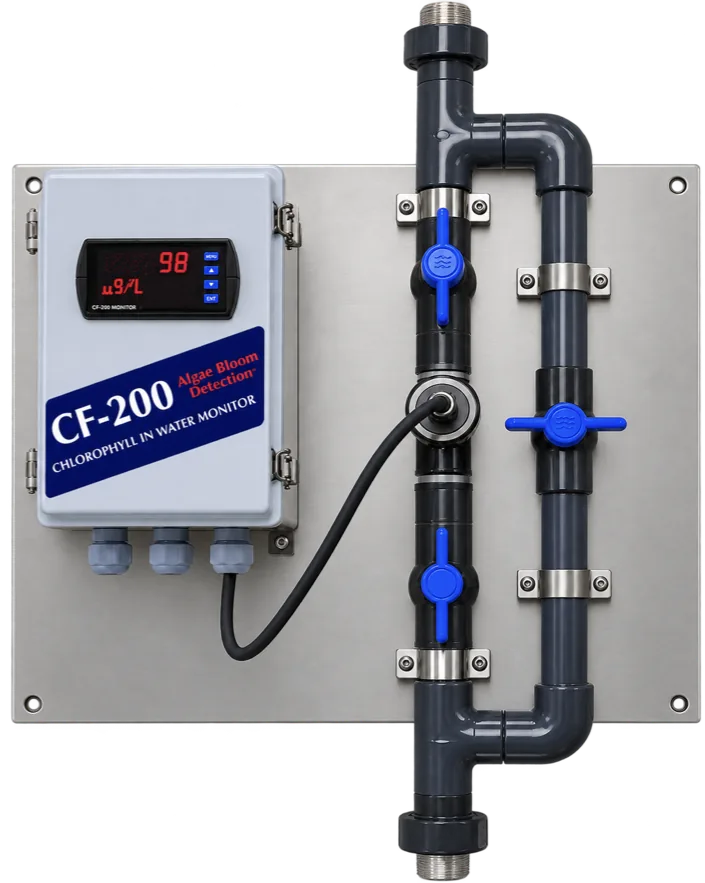
The CF-200 algae bloom monitor combines a C-Fluor fluorescence probe, bypass assembly, display and transmitter for continuous chlorophyll-A measurement. It is supplied as an integrated assembly on a 316 stainless-steel backplate.
Chlorophyll A is a primary pigment in algae. Its fluorescence measurement provides an indicator of changing algal biomass in fresh or sea water, helping operators recognise conditions that may affect an intake or treatment process.
The CF-200 is part of PMA’s Turner Designs and associated water-monitoring offering. Its measurement is chlorophyll A, with a separate role from the TD-550, TD-560 and TD-120 oil instruments.
Track changes in chlorophyll-A response rather than relying solely on intermittent samples. Review seasonal behaviour and the site’s operating context when interpreting the trend.
The display/controller provides two alarm relays and a 4–20 mA output. Agree signal scaling, thresholds and the operator response with your control-system team.
The isolation and bypass arrangement provides access for cleaning. The instrument uses no chemicals or reagents and has no moving parts in its measurement assembly.
Published manufacturer specifications are a starting point. Confirm the supplied configuration, target sample and installation conditions with PMA.
Chlorophyll-A fluorescence using the C-Fluor probe. Published chlorophyll measurement range: 0–100 µg/L.
1-inch PVC union fitting with threaded or socket connection. Confirm the supplied connection and pipework arrangement.
Titanium metallic and CPVC wetted parts; maximum pressure 3 bar (45 psi). Review material compatibility for your water.
4–20 mA output, loop or internally powered, plus two 3A form-C alarm relays on the display/controller.
85–275 VAC supply to the display/controller; maximum power consumption 20 W.
NEMA 4X / IP65 display-controller rating; published controller operating range −40 to 65°C. These controller ratings do not define the complete sample/probe operating limits.
Recognise changing algae-related conditions before they affect industrial processes using seawater. Site conditions, season and weather can change the background.
Use the chlorophyll-A trend to support intake and pretreatment decisions ahead of reverse-osmosis membranes. Agree thresholds for the specific installation.
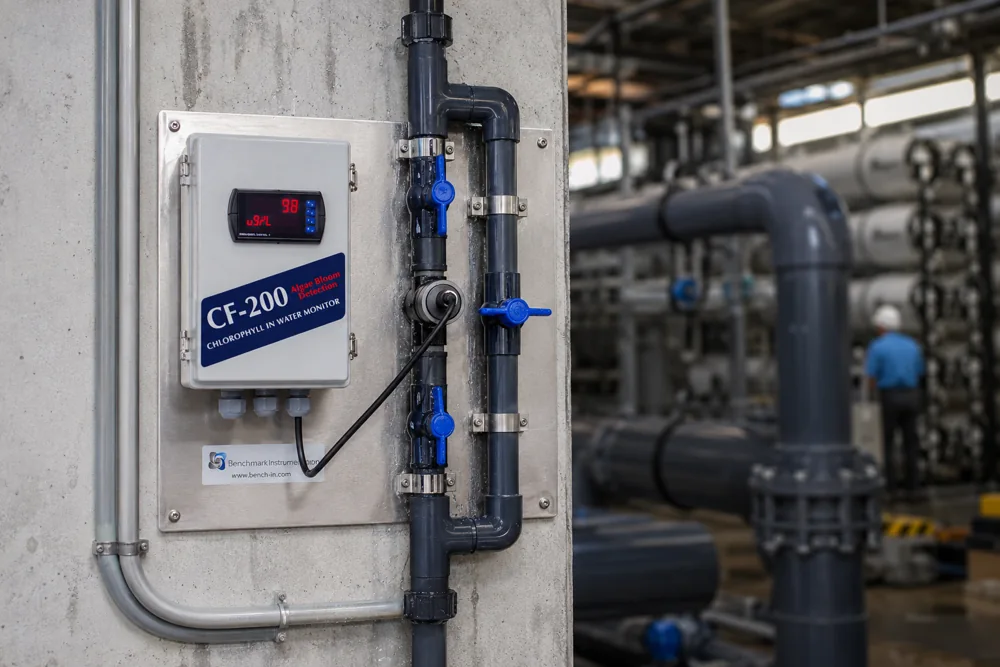
Discuss a representative bypass sampling point for reservoir, lake or river water. Include flow, cleaning access and the meaning of the seasonal baseline.
Combine continuous information with site observations and laboratory sampling where needed. Confirm the intended operational response to rising chlorophyll A.
A chlorophyll-A measurement does not identify every algal species and does not directly measure cyanotoxins. It should inform the site’s monitoring programme alongside other observations and analyses required for the risk being managed.
There is no single alarm threshold suitable for every water body or treatment process. Define the normal baseline, seasonal variation, sampling arrangement and action level with the responsible site team.
PMA can help review the installation, control signal and access for maintenance. Provide the water source, expected chlorophyll-A range, process pressure and the decision the alarm should support.
Review the measurement principle, published specifications and available features for this product.
Send your sample conditions and operational objective so PMA can review the right configuration.
Chlorophyll A is a pigment-based indicator of algal biomass. A fluorescence result does not automatically identify species or translate into a universal cell count.
No. The CF-200 measures chlorophyll A. If toxin risk is part of your monitoring objective, include the appropriate additional sampling and analysis.
Use the site’s baseline, seasonal conditions, sampling setup and treatment objectives. Agree the threshold and the operational response for that installation.
Grab-sample oil analysis for crude and heavier oils. Review target-oil calibration, sample preparation and recorded results.
Portable analysis with a second optical channel for lighter hydrocarbons as well as the oils measured by the TD-550.
Continuous UV fluorescence measurement for oil contamination, process protection and treatment monitoring.
Compare portable oil analysis, continuous oil monitoring and chlorophyll-A measurement with PMA.
Speak to the PMA team about your instruments, reagents or service requirements. Tell us what you need, and we’ll help you find the right next step.
Share your requirements below. All fields are required.
Your enquiry goes directly to our team. Your details are used to respond to you, and you won’t be added to a marketing database. Read our privacy policy.
To find out more about our range of sensors, request a callback or ask a technical question, our expert staff are always on hand. Our focus has always been to deliver world-class customer service.
Get startedWe use optional Google Analytics cookies to understand which pages are useful. Analytics stays off unless you accept. Read our privacy statement.