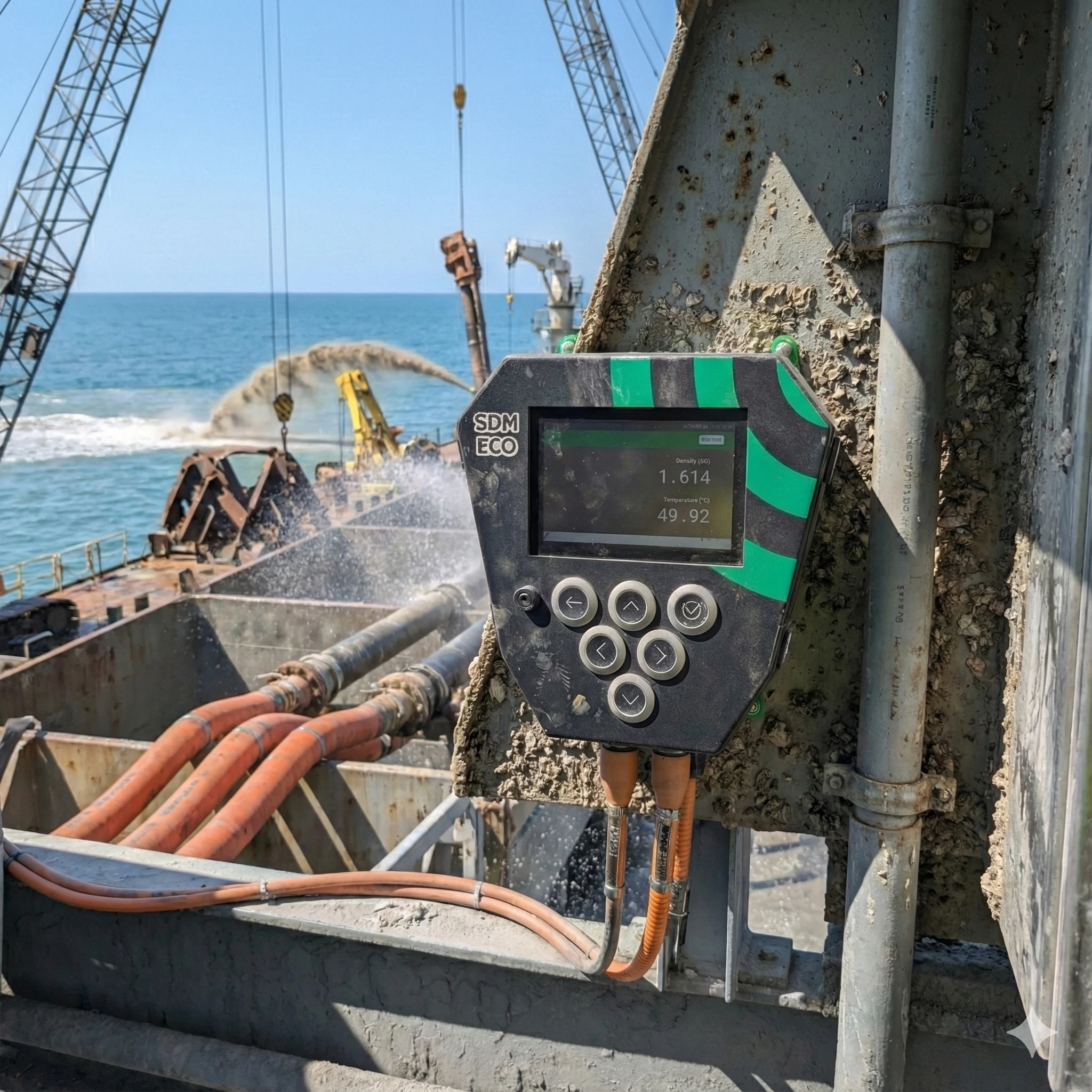
Name the measurement locations
Mark the density meter, flow meter, sampling point, pumps and branches on a simple line drawing. Record any water addition or diversion between them.
Where the points are separated, establish how transport time will be accounted for. A simultaneous timestamp is not proof that both instruments saw the same material.
Align the interval and units
Record the start and finish time, flow-total readings, density units and the source of each logged value. Confirm clock alignment, averaging and the period represented by a transmitted reading.
Check whether a density value is instantaneous or averaged before using it with an interval total. Retain enough data to review changing conditions within that interval.
Identify gaps and transitions
Mark water-only running, pump stops, flushing, empty or partly filled conditions and unavailable signals. Record the rule used to include, exclude or flag each interval.
Do not silently carry the last valid density across a signal gap. Keep any substituted value identifiable in the calculation record.
State the calculation basis
Keep the flow-to-volume step separate from the density-to-mass step. Multiplying representative slurry density by the corresponding transferred volume gives slurry mass on that stated basis.
A dry-solids result needs an additional validated concentration relationship or reference, with its material assumptions recorded. Do not label slurry mass as dry solids.