Use an exact channel name
Label free or total chlorine explicitly, with reporting units and method. If both are required, confirm the supported configuration and retain the timing of each result.



Connect the selected chlorine result to sample travel, operating state and reference checks.
Free and total chlorine answer different measurement questions. Define the required channel and monitoring point before selecting the analyser. Locate the take-off relative to dosing, mixing, storage and blending, and identify any alternative water route that could change the sample reaching it.
The 3S colourimeter provides DPD-based free and total chlorine configurations for drinking-water applications. Review the selected method, range and sample against the duty. It performs repeated batch analyses, so the response includes sample transport and the configured analysis interval. Match these to the operating decision rather than treating the result as an instantaneous in-pipe signal.
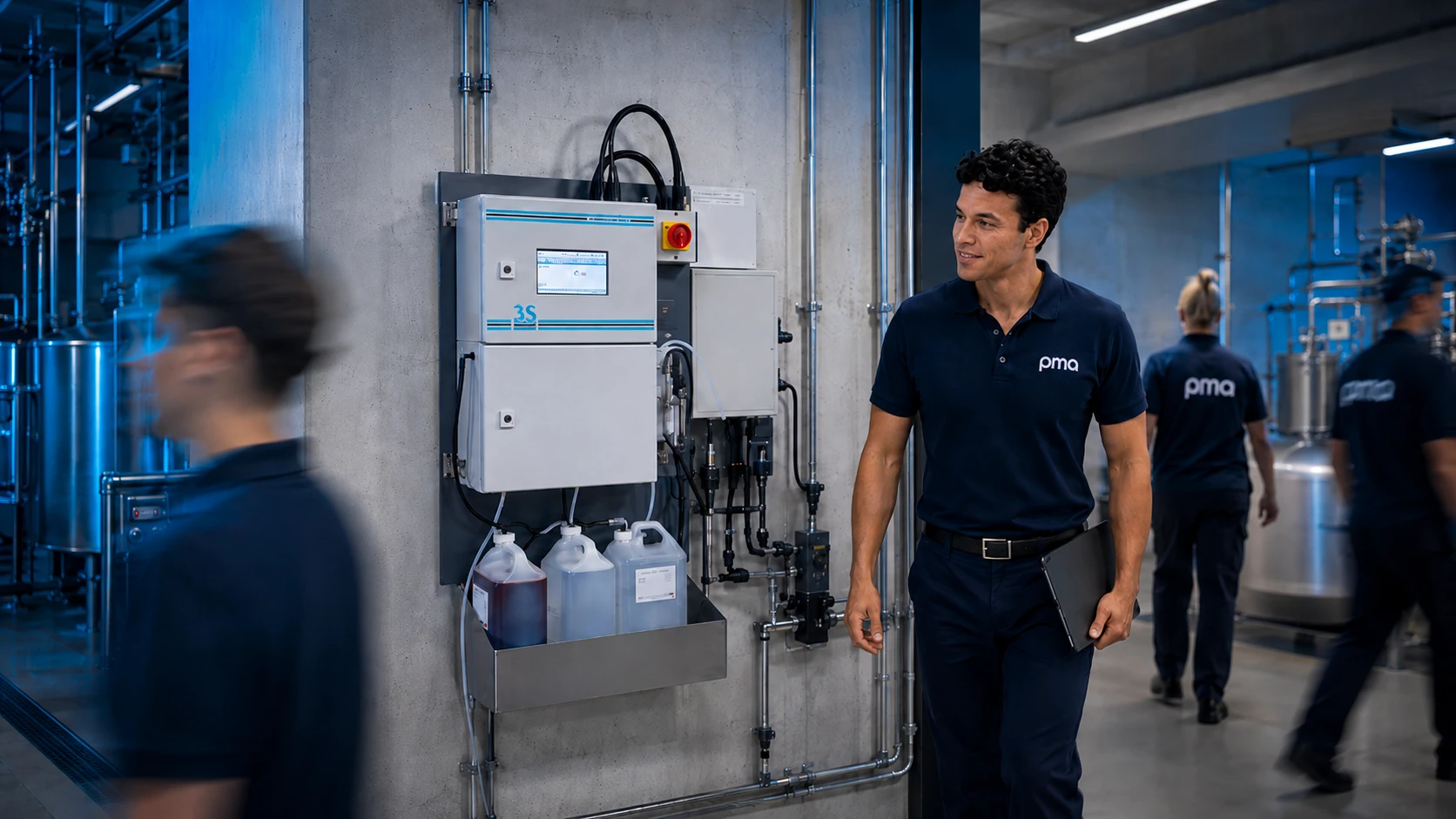
Keep the measurement definition, water route and timing visible to the people reviewing the trend.
Label free or total chlorine explicitly, with reporting units and method. If both are required, confirm the supported configuration and retain the timing of each result.
Record the take-off, pipework, reservoir or fast loop, analyser inlet and drain. Assess sample travel and any conditions that could change the sample before measurement.
Keep dose delivery, plant flow, supply switching and relevant water-quality observations alongside the residual. Preserve the time and point for each record.
Retain cleaning, calibration, validation, reagent replacement and sample-flow interruptions. Mark invalid or missing results instead of presenting them as a low residual.
Build the comparison around the same water, chlorine definition and measurement timing.
Review the current route and sample delivery before attributing a reading change to dose performance. Check whether stored or delayed water could explain the timing.
Use the agreed method at the defined point and record when the sample was collected and tested. Compare the correct free/total result and units with the corresponding online reading.
Share other disinfectants and constituents that may affect the selected method. Confirm suitability for the actual sample rather than assuming the chlorine label covers every oxidant.
Record evidence, operator action and the next review time under the site’s procedures. Keep process decisions distinct from analyser maintenance or sample-system changes.
Send the free/total measurement requirement, expected range, dosing and sampling drawing and current reference method. Include sample conditions, other disinfectants, travel time, required update interval and plant outputs. PMA can review the method and sample system around the response your operating team needs.
PMA connects the measurement, installation and operating team. We help you review the application, select suitable instrumentation and plan commissioning, training and ongoing service.
Speak to the PMA team about your instruments, reagents or service requirements. Tell us what you need, and we’ll help you find the right next step.
Trusted by our clients


Share your requirements below. All fields are required.
Your enquiry goes directly to our team. Your details are used to respond to you, and you won’t be added to a marketing database. Read our privacy policy.
To find out more about our range of sensors, request a callback or ask a technical question, our expert staff are always on hand. Our focus has always been to deliver world-class customer service.
Get startedWe use optional Google Analytics cookies to understand which pages are useful. Analytics stays off unless you accept. Read our privacy statement.