Sample point
Water drawn after the manganese treatment stage.


An MP5 field trial: clean electrodes, a sample-flow investigation and a verified return to service.
After approximately three months on a post-manganese treatment sample, an MP5 free-chlorine sensor appeared to lose its residual reading. The investigation found an interrupted sample supply. Inspection also showed that the sensing surfaces remained clean despite deposits inside the end cap.
The manufacturer’s visit report records a return to the correct residual without adjustment or calibration, verified with a handheld colorimeter.
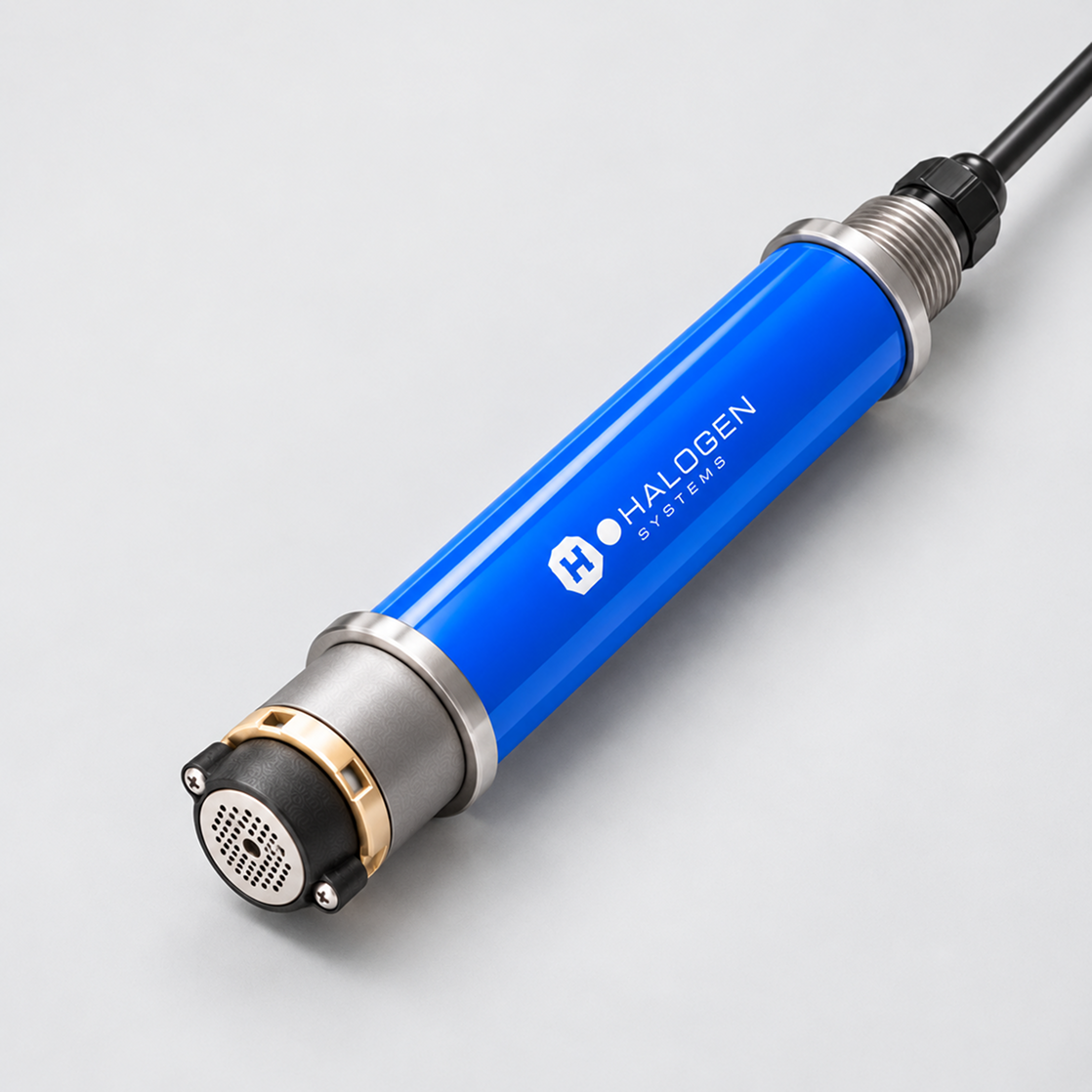
Discuss your monitoring pointThe MP5 measured free chlorine in a flow cell supplied from a post-manganese sample point. Portal trends supported the investigation; a separate colorimetric check verified the returned reading.
Water drawn after the manganese treatment stage.
An isolation valve controlled the supply to the flow cell.
Free chlorine followed alongside pH, conductivity and temperature.
Portal history and a handheld colorimeter supplied complementary evidence.
The chlorine trend fell to zero while pH and conductivity remained normal and temperature rose. The report interpreted the pattern as a likely loss of sample flow.
Decayed towards zero.
Remained normal.
Remained normal.
Rose during the interruption.
The decisive check: the visit confirmed there was no flow to the flow cell. Fully opening the isolation valve restored the sample supply. Whether the valve had closed or become airlocked was not resolved in the report.
Qualitative summary of the report’s observations, not a reconstructed time-series chart.
The end cap was visibly brown, with iron and manganese deposits inside it. Its pores and holes remained unblocked. Removing the cap revealed clean pH and chlorine sensing surfaces.
These inspection findings supported the report’s conclusion that the mechanical cleaning system had kept the electrodes in good working order during this trial.
The sequence matters: sample supply, sensor condition and reference confirmation were checked together.
The isolation valve was fully opened and water returned to the flow cell.
A difference from the incumbent analyser prompted a visual inspection of the cap and electrodes.
The MP5 was returned to service without adjustment or calibration.
The report records the correct reading within one minute, confirmed by a handheld colorimeter.
The trial illustrates the value of self-cleaning sensing surfaces alongside a dependable, representative sample supply.
Investigate valves, sample movement and possible airlocks when a residual signal changes unexpectedly. A clean sensor still needs fresh sample water.
Temperature, pH and conductivity can add context to the chlorine trend. Use the full operating picture to guide the next physical check.
Confirm the returned reading with an appropriate reference method. Use the trial as application evidence, not a universal maintenance interval.
This is an anonymised account of one manufacturer site-visit report. It records approximately three months of operation and the findings of that visit. It does not provide a controlled accuracy study, a complete raw dataset or numerical iron and manganese concentrations. The one-minute observation is a reported recovery after return to service, not a formal response-time specification.
Source: Halogen Systems site-visit report, September 2026, pages 1–3. Customer details are withheld. The original report remains private.
PMA connects the measurement, installation and operating team. We help you review the application, select suitable instrumentation and plan commissioning, training and ongoing service.
Talk to the PMA teamSpeak to the PMA team about your instruments, reagents or service requirements. Tell us what you need, and we’ll help you find the right next step.
Share your requirements below. All fields are required.
Your enquiry goes directly to our team. Your details are used to respond to you, and you won’t be added to a marketing database. Read our privacy policy.
To find out more about our range of sensors, request a callback or ask a technical question, our expert staff are always on hand. Our focus has always been to deliver world-class customer service.
Get startedWe use optional Google Analytics cookies to understand which pages are useful. Analytics stays off unless you accept. Read our privacy statement.