Freshwater intakes
Follow changes in incoming river or reservoir water and decide when additional sampling or a treatment review is needed.


Track changing algae levels at your water intake with continuous CF-200 monitoring and practical PMA support.
Chlorophyll-A is a photosynthetic pigment found in algae and cyanobacteria. Measuring its fluorescence provides an indicator of changing algal biomass and helps operators see trends between individual sample checks.
Use those trends alongside site observations and reference analysis to review intake conditions, pretreatment and operating response. The objective is useful information for your process, with a clear understanding of what the measurement represents.
Start with the water source and the operating decision that an online trend needs to support.
Follow changes in incoming river or reservoir water and decide when additional sampling or a treatment review is needed.
Monitor chlorophyll-A at seawater intakes and around pretreatment, where changing plankton levels can affect downstream operation.
Compare a continuous trend with operating records and time-matched samples to investigate seasonal changes or unusual intake conditions.
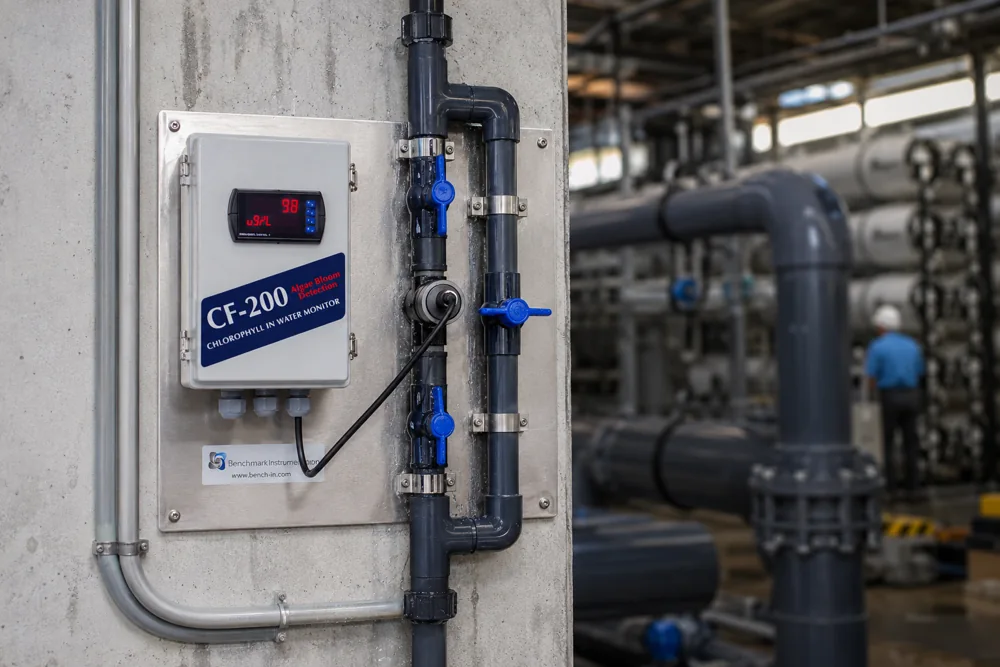
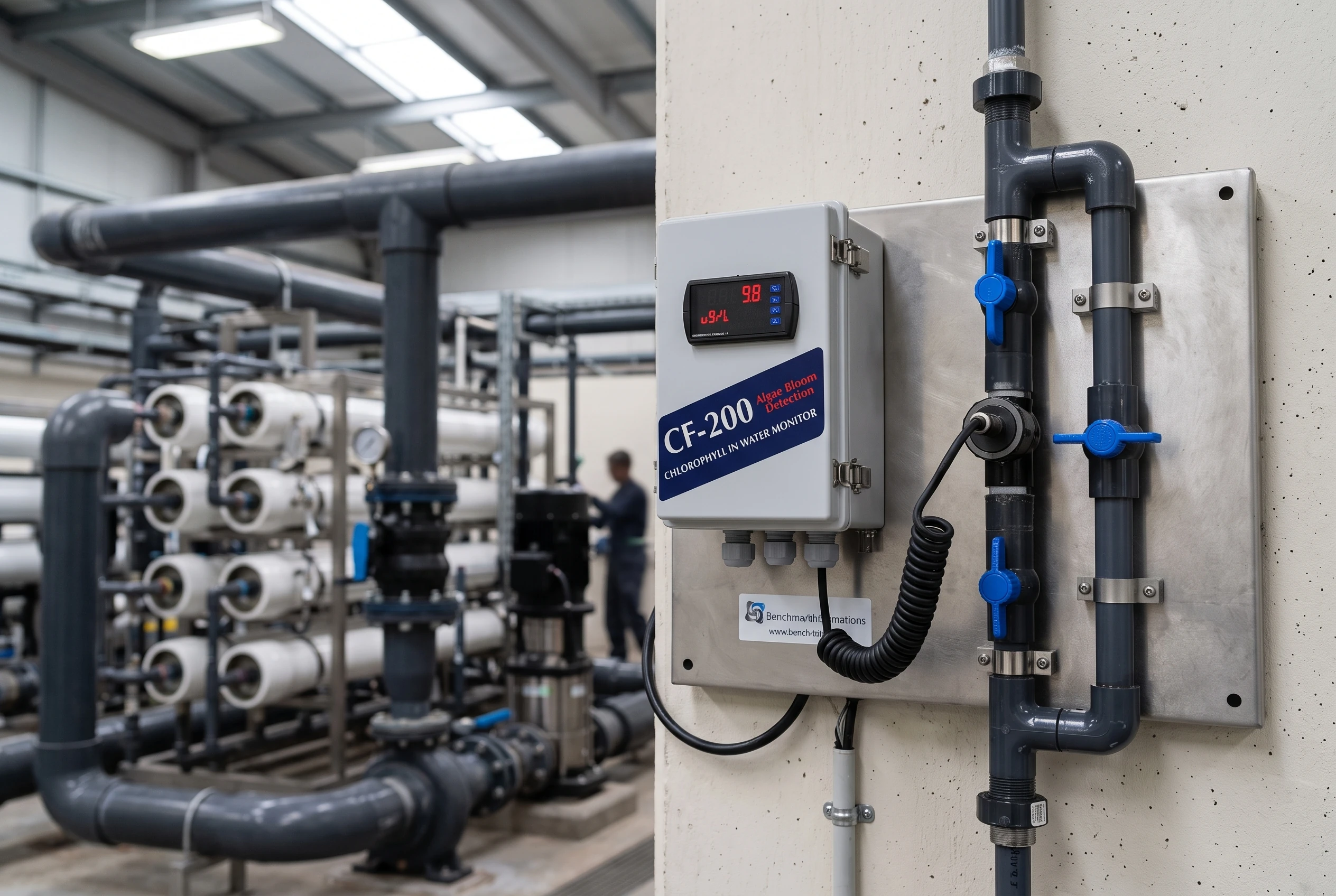
The CF-200 combines a fluorescence probe, bypass assembly, local display and transmitter for continuous chlorophyll-A measurement in fresh or sea water. Its optical measurement uses no analytical reagents.
The controller provides a 4–20 mA signal and alarm relays for connection to plant systems. Review the measuring range, installation conditions, sample supply and alarm settings against your specific application.
Select a representative sample and suitable bypass location. Review utilities, access, isolation and the route back to the process or drain.
Compare trends with appropriate reference samples and site conditions. Agree reporting units, calibration checks and operating thresholds.
Record maintenance and changing process conditions. Use a cleaning and inspection routine appropriate to the installation and investigate unexpected readings.
Give a chlorophyll-A trend change a clear source-water record. Keep the original trend, the intake operating state and follow-up evidence together so another shift can review the same event.
The record supports investigation. Species identification, cyanobacterial counts and toxin assessment remain separate questions requiring appropriate analysis.
Record the water body, intake route, pump or take-off and monitor ID. Include the sampling depth where known and any change of intake arrangement. A source-water trend needs that location and operating state to remain interpretable.
Record relevant observations and available weather, tide or flow information with their times and sources. Keep observations separate from an assumed bloom cause. A coincident weather change does not establish why the fluorescence changed.
Give reference samples and laboratory reports their own IDs, collection points and times. Identify what each analysis answers, such as pigment estimation, species identification or toxin testing. Do not combine unlike results into a single algae count.
Record the site response, who owns the next check and the time for review. Keep unresolved differences and any interrupted monitoring period visible. A return to the earlier trend does not by itself establish that the source-water concern has been resolved.
PMA connects the measurement, installation and operating team. We help you review the application, select suitable instrumentation and plan commissioning, training and ongoing service.
A chlorophyll-A reading does not identify species or directly measure cyanobacterial cell counts or cyanotoxin concentration. Cyanobacteria are often called blue-green algae and also contain chlorophyll. Use suitable additional analysis when identification or toxin assessment is required; a low chlorophyll-A result alone does not demonstrate that water is safe.
Monitoring does not remove algae. It supplies information to support investigation and a site-specific management or treatment plan. The appropriate response depends on the water source, the organisms present and the intended use of the water.
Tell us whether the source is fresh or sea water, where you want to sample, the expected conditions, the available reference results and the decision you need to make. Include the required plant outputs and installation constraints.
Speak to the PMA team about your instruments, reagents or service requirements. Tell us what you need, and we’ll help you find the right next step.
Trusted by our clients


Share your requirements below. All fields are required.
Your enquiry goes directly to our team. Your details are used to respond to you, and you won’t be added to a marketing database. Read our privacy policy.
To find out more about our range of sensors, request a callback or ask a technical question, our expert staff are always on hand. Our focus has always been to deliver world-class customer service.
Get startedWe use optional Google Analytics cookies to understand which pages are useful. Analytics stays off unless you accept. Read our privacy statement.