Map the sample point
Link the monitor ID and sample take-off to a named membrane unit or common header. If several units feed one header, record that limitation: the common trend does not identify an individual unit as the source of a change.


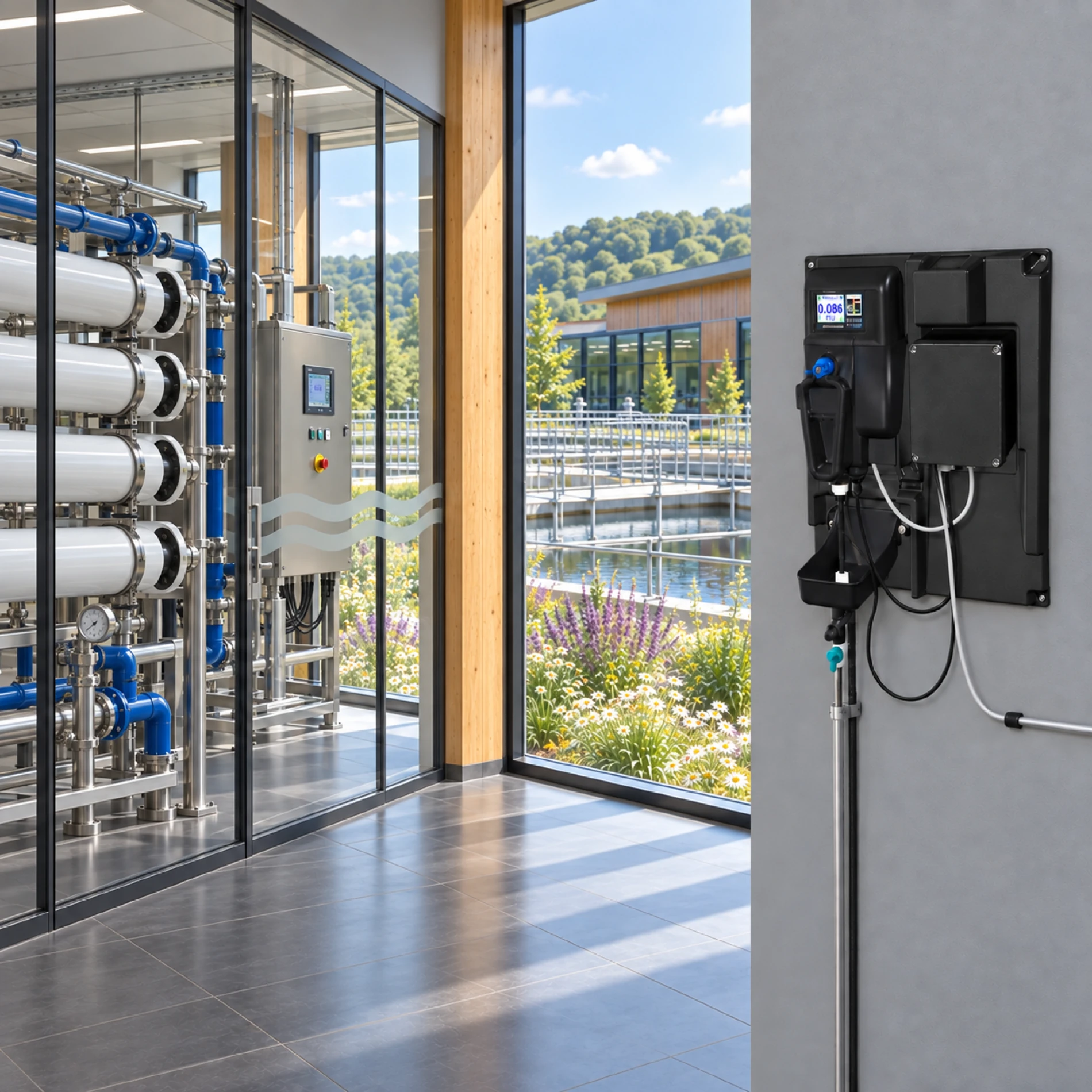
Connect the filtrate trend to its membrane unit and keep direct integrity-test evidence clearly identified.
For low-pressure microfiltration and ultrafiltration used in drinking-water treatment, continuous filtrate turbidity is an indirect monitoring signal. A direct integrity test provides a different type of evidence. Record both against the correct membrane unit without treating them as interchangeable results.
The Lovibond PTV 1000 can be considered where the filtrate is within the selected model’s low-level drinking-water application. Confirm the optical method and sample installation with PMA. This guidance concerns MF/UF filtrate; it does not establish reverse-osmosis performance.
Build the record around the unit that produced the water. The useful question is what was operating, what evidence belongs to that unit and what the site procedure requires next.
Link the monitor ID and sample take-off to a named membrane unit or common header. If several units feed one header, record that limitation: the common trend does not identify an individual unit as the source of a change.
Keep production, backwash, cleaning, restart and out-of-service periods distinguishable in the trend. Record which units were feeding the header. A change of unit combination can alter what a common monitoring point represents.
Record the direct integrity-test reference, unit, time window and result separately from the turbidity trend. Link the records so an operator can retrieve the test evidence. Do not derive membrane log-removal performance from a low turbidity reading.
Mark interruptions, sample-system work and verification periods rather than joining them into an apparently continuous valid trend. For an event, record the investigation, responsible operator and next review under the site’s approved response procedure.
Low filtrate turbidity alone does not prove an intact membrane or demonstrate pathogen removal. The sensitivity of an indirect turbidity signal and a direct integrity test differs. Keep the site’s validated integrity-testing approach, limits and response procedure as the authority for operational decisions.
For a trend excursion, first retain the unit and operating-state record. Check the sample path and instrument status while following the site response. Avoid closing the event solely because the displayed turbidity has returned to its earlier level.
The US EPA-hosted low-pressure membrane optimisation guidance explains direct and indirect monitoring. It is technical background, not a statement of UK operating requirements.
Send PMA the membrane process type, unit and header arrangement, proposed sample take-off, expected filtrate characteristics and the site’s monitoring purpose. Include sample flow and drain arrangements, the required instrument connection and how the turbidity record will be linked to integrity-test records.
Review installation, calibration, verification and maintenance alongside the site’s own procedures.
Check the optical method, measurement point and practical installation requirements.
Build a filter-run and event record for the treatment stage upstream of these applications.
Use a separate application record when the water and operational purpose change.
Speak to the PMA team about your instruments, reagents or service requirements. Tell us what you need, and we’ll help you find the right next step.
Trusted by our clients


Share your requirements below. All fields are required.
Your enquiry goes directly to our team. Your details are used to respond to you, and you won’t be added to a marketing database. Read our privacy policy.
To find out more about our range of sensors, request a callback or ask a technical question, our expert staff are always on hand. Our focus has always been to deliver world-class customer service.
Get startedWe use optional Google Analytics cookies to understand which pages are useful. Analytics stays off unless you accept. Read our privacy statement.