Low sample consumption
A low-flow design and small-volume flow body help limit sample and calibration-standard consumption. Confirm the required flow range for your selected configuration.


Continuous low-level turbidity measurement for drinking water, with configuration advice and practical support from PMA.
Reliable low-level measurement starts with a representative sample. Stable flow, effective bubble control and an accessible sample path help operators follow changes in drinking-water turbidity while keeping routine checks and cleaning manageable.
Calibration and verification provide a practical way to check instrument performance over time. PMA can help you plan the sample connection, choose the appropriate configuration and establish an installation and maintenance routine that suits your site.
The Lovibond PTV 1000 is an online turbidity analyser for continuous low-level drinking-water measurement. Also called a process turbidimeter or online turbidity meter, it monitors a flowing sample rather than an occasional bottle sample.
A compact flow body, integrated bubble trap and guided interface help operators manage the measurement from installation through to calibration and maintenance.
PMA can help you select the optical configuration and installation approach for your water quality monitoring requirements.

A low-flow design and small-volume flow body help limit sample and calibration-standard consumption. Confirm the required flow range for your selected configuration.
A wall-mounted system with accessible components, an integrated bubble trap and a compact footprint.
Infrared and white-light configurations are available for different measurement methods. Ask PMA to confirm the appropriate model for your application.
Touchscreen operation, guided calibration and verification, with AquaLXP app functionality for supported configurations.
Explore the brochure or follow the step-by-step video guides.
The integrated, patented bubble trap reduces bubble interference while keeping the flow path accessible for cleaning.
An internal light dump captures stray light to support measurement reproducibility at low turbidity levels.
The small-volume flow body helps water move through the instrument quickly, supporting a responsive measurement and easier cleaning.
T-CAL stabilised formazin standards in T-CALplus packaging provide a sealed approach to calibration, reducing direct handling and helping to avoid spills.
Secondary solid verification standards provide a practical way to check instrument performance between calibrations.
The video guide explains how to assign a value to the verification block. The high-level block is demonstrated; the same baseline procedure applies to the low-level block.
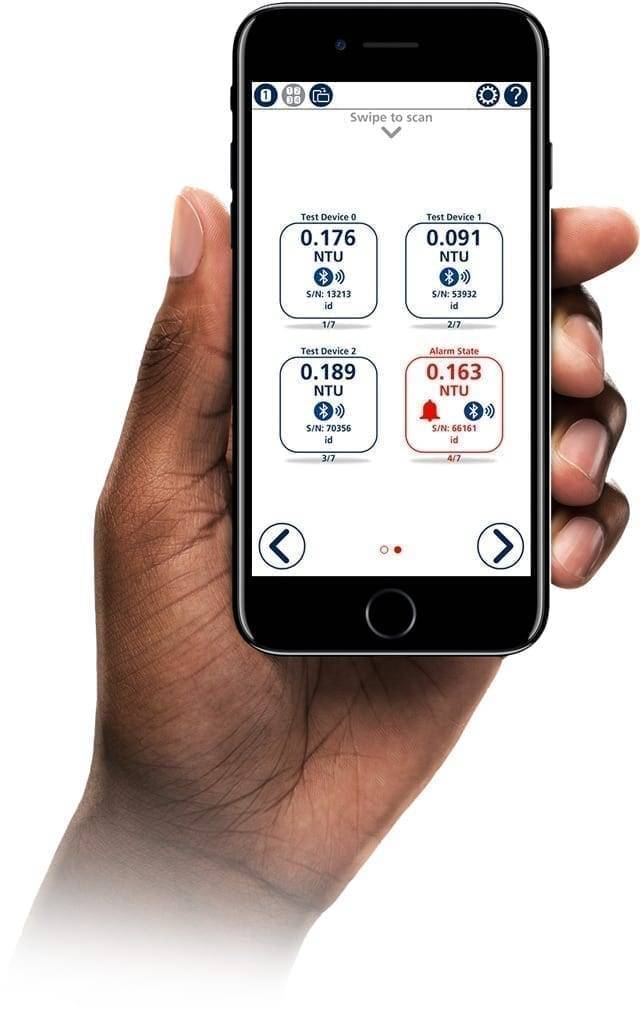
Use the touchscreen interface or AquaLXP app on supported iOS and Android devices to work with measurements and instrument records.
On-screen instructions support calibration, verification, cleaning and maintenance.
Proximity connection and password-protected operator and supervisor functions help manage access.
Record measurements and service activity in the instrument’s lifetime log.
View information in graphs or tables and export data for further review.
An overview of the PTV 1000 and its approach to online turbidity measurement.
Mike Sadar’s white paper comparing the PTV 1000 with the 1720E.
Review the manufacturer’s short PTV 1000 specification and confirm the current optical model with PMA.
Explore expert insights, step-by-step videos and application guidance to support your next measurement decision.
Explore Mike Sadar’s interview for practical insight into turbidity measurement.
Follow installation, calibration, verification and maintenance demonstrations.
Explore the role of online turbidity in identifying flow-accelerated corrosion.
Discover ten common challenges that make turbidity measurement demanding.
“We have installed 3 demonstration units and each installation was a breeze that delivered excellent data. You can immediately tell it is a better measurement than the older technology by the lower reading it provides. The patented light dump does an excellent job of eliminating stray light.”
M. Lynch · historical product feedback

Lovibond Tintometer supplies water analysis equipment for leisure, environmental and industrial applications. Speak to PMA about selecting and supporting the right instrument for your site.
The PTV 1000 is available with different optics. Specify the actual model and measurement method rather than treating every PTV instrument as interchangeable.
Read the manufacturer’s specification or ask PMA to confirm the model, accessories and current performance figures for your application.
These terms, including the US spelling “turbidity analyzer”, commonly describe instruments that measure turbidity. The PTV 1000 is a continuous online process instrument; a portable meter serves a different sampling workflow.
Its low-level design suits filtered and treated drinking water. A filter-effluent application needs a representative sample and a stable installation as well as the correct instrument. Discuss other water matrices with PMA before selecting a model.
The units reflect different optical methods. Instruments may agree on a calibration standard while responding differently to real water samples. Keep the method, optical model and units clear when comparing data.
No. Calibration establishes the instrument response using the specified primary standard. Dry-block verification checks performance against an assigned reference; it does not replace the wet calibration procedure.
Follow the next step that fits your application or instrument.
Assess sample points and practical conditions after drinking-water filtration.
Compare methods, sample handling and operating requirements.
Follow installation, calibration, verification and maintenance guides.
For other water matrices and instruments, explore PMA’s turbidity measurement overview.
Connect low-level turbidity monitoring to the water and the operational decision at each location.
Record storage and transfer events with the flow route, water travel and operator handover.
Keep MF/UF filtrate trends linked to the membrane unit and distinct from direct integrity-test evidence.
Speak to the PMA team about your instruments, reagents or service requirements. Tell us what you need, and we’ll help you find the right next step.
Trusted by our clients


Share your requirements below. All fields are required.
Your enquiry goes directly to our team. Your details are used to respond to you, and you won’t be added to a marketing database. Read our privacy policy.
To find out more about our range of sensors, request a callback or ask a technical question, our expert staff are always on hand. Our focus has always been to deliver world-class customer service.
Get startedWe use optional Google Analytics cookies to understand which pages are useful. Analytics stays off unless you accept. Read our privacy statement.