
A nitrate result can be useful and still leave an important question unanswered: what is happening to nitrite? For UK water and wastewater engineers, specifying a nitrogen analyser begins with deciding which species must be measured, where the sample comes from and what decision the result will support.
Nitrate and nitrite are different chemical species. Treating them as interchangeable can hide information when investigating a treatment process or comparing an online trend with laboratory results. Separate measurements make the record clearer.
Specify the result before choosing the instrument
An enquiry that asks only for a “nitrate sensor” can cover several requirements: an immersed probe, a sample-fed analyser, a temporary monitoring campaign or a fixed installation. Start with the measurement range and the lowest concentration that needs to be distinguished reliably in the actual sample.
Then decide whether nitrate alone is sufficient. PMA’s guidance on online nitrate monitoring and nitrite measurement provides separate starting points. A final effluent check, a treatment investigation and a raw-water survey may require different sampling arrangements.
Make the reporting units explicit
Results may be expressed as nitrate or nitrite ions, or as the nitrogen contained in them. A value labelled mg/L NO₃ is not numerically equivalent to mg/L NO₃-N. The same distinction applies to NO₂ and NO₂-N. “mg/L” alone is an incomplete label for a useful comparison.
Confirm the reporting basis on the analyser, laboratory report, data logger and SCADA display. Record any conversion in the data configuration so that operators can trace it. Keep nitrate and nitrite channels clearly named, including their units, when exporting trends or setting up reports.
Check the measurement basis
Before comparing two nitrogen results, check what each instrument measures and how it reports the units.
Understand the sampling cycle
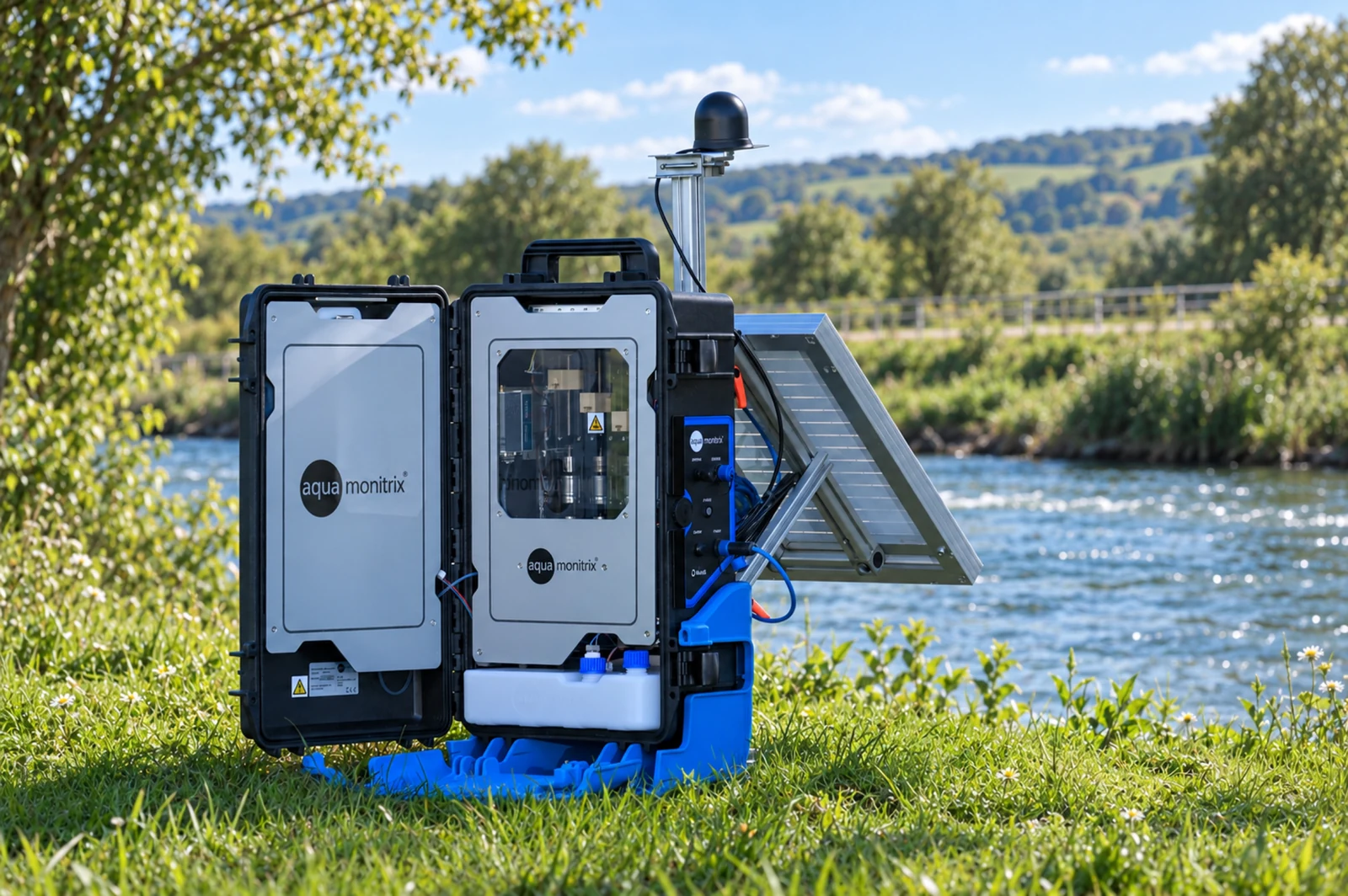
The Aquamonitrix analyser separates nitrate and nitrite using chromatography and measures them with UV detection. That is a sample-analysis cycle, rather than a continuously immersed optical probe. The manufacturer’s NOx-monitrix Mobile information explains the current mobile configuration.
An analysis interval and a sample transport delay are different things. Water must first reach the analyser; the instrument then processes the sample. For a changing process, compare those combined delays with the speed of the event you want to observe. A short event may need a different sampling strategy from a daily trend.
Plan for the site, not just the measurement range
- Describe the sample matrix, expected solids and any conditioning before analysis.
- Identify a representative sampling point and the route to the instrument.
- Check power, drainage, shelter, communications and maintenance access.
- Agree how missing results, servicing periods and instrument alarms will appear in the record.
For a temporary UK catchment or outfall project, remote water monitoring also needs a practical plan for visits, consumables and retrieving data. A sheltered location and a realistic service routine matter as much as the communications link.
Send PMA the sample type, expected nitrate and nitrite ranges, required units and monitoring interval. We can review an appropriate Aquamonitrix configuration for your application and prepare a quotation.