Configurable alarm response
Four dry-contact alarm relays can support the agreed warning and system conditions. Define who responds to an alarm and how it relates to plant protection.


Continuous UV fluorescence measurement for contamination detection, process protection and reliable operational decisions.
The Turner Designs TD-120 is a continuous online oil-in-water monitor using UV fluorescence. It measures suitable hydrocarbon targets in a flowing sample and provides a local indication, configurable alarms and an isolated 4–20 mA signal.
The manufacturer lists diesel, fuel oil, crude oil, gasoline, jet fuel, lubricating oils, phenol, heat-transfer fluids and aromatic chemicals. Confirm the response to the actual fluid or mixture you need to detect.
The TD-120 operates without reagents or instrument air. An internal tablet supports configuration and calibration, while the external interface provides access to events, history and maintenance information.
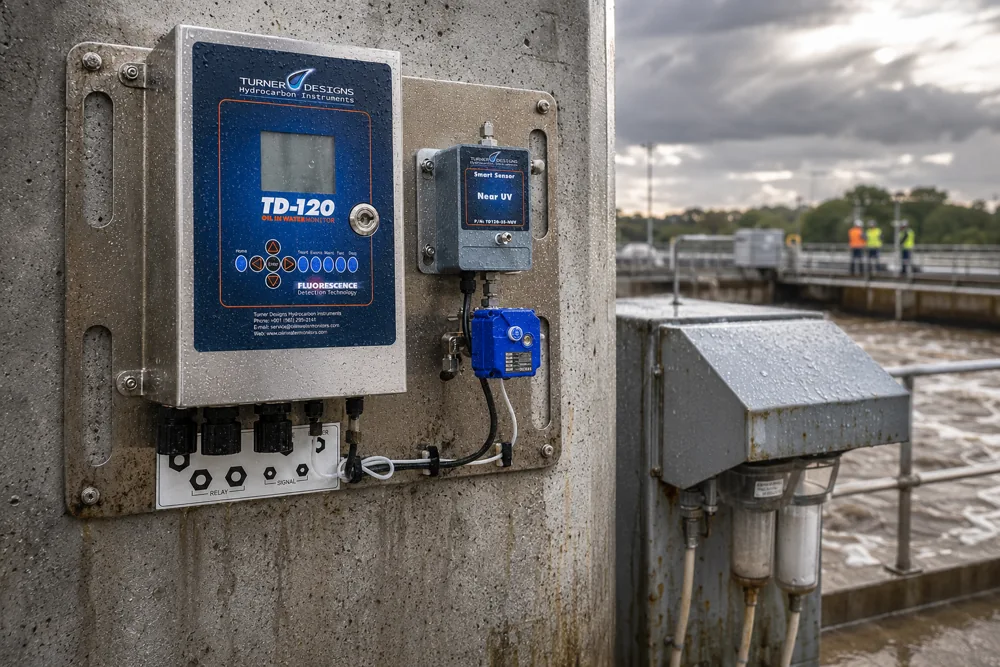
Four dry-contact alarm relays can support the agreed warning and system conditions. Define who responds to an alarm and how it relates to plant protection.
Use the isolated 4–20 mA output for integration; HART is an optional communication feature. Confirm signal scaling, power arrangement and interface requirements.
Available auto-valve capabilities include temperature protection, fresh-water flushing and process isolation. Confirm the supplied package rather than assuming every feature is standard.
Published manufacturer specifications are a starting point. Confirm the supplied configuration, target sample and installation conditions with PMA.
Published low ppb–6000 ppm range, dependent on oil solubility in water and sample background. Select calibration for the target hydrocarbon.
3 seconds default, user-adjustable down to 0.5 seconds. Include sampling-line transport and conditioning when assessing total system response.
Recommended 1–2 L/min; published limits 0.1–3 L/min. An optional sample pump is available.
0–50°C sample temperature and 10–100 psig (69–690 kPag) sample inlet pressure. Consult PMA for conditions outside these limits.
0–55°C ambient operating temperature; 100–240 VAC, 50/60 Hz supply. Assess weather protection, siting and access for the installed assembly.
Wall-mounted unit: 406 × 508 × 140 mm, 10.9 kg. Isolated 4–20 mA, optional HART and four configurable alarm relays.
Monitor for changing hydrocarbon contamination from process leaks or heat exchangers. Agree the target oil and normal water background.
Assess contamination before condensate is returned. Confirm sample cooling and a representative flow within the instrument limits.
Use a configured oil warning to inform the site’s response to contamination. Plan sampling, thresholds and any isolation actions together.
Track suitable hydrocarbon response through a defined monitoring point to support operational investigation and treatment decisions.
A fast optical reading is useful only when the sample reaching the flow cell represents the process. Review the sampling point, tubing route, line length, flow, cooling and cleaning arrangements before finalising the installation.
Provide the target hydrocarbon, expected concentration and normal background. Calibration may be to a known standard or to the target hydrocarbon using sample analysis, depending on the agreed care package.
Plan routine flow-cell inspection, sample-line checks and access for flushing and isolation. Reagent-free operation does not remove the need for appropriate maintenance.

Review the measurement principle, published specifications and available features for this product.
Send your sample conditions and operational objective so PMA can review the right configuration.
The TD-120 measures a fluorescence response from suitable target hydrocarbons. It is not a universal measurement of every aliphatic or aromatic compound; define the target and calibration for the application.
That is the published minimum configurable instrument response. Sampling-line travel time, conditioning and the control-system setup also affect the time from a process change to an operational response.
No reagents or instrument air are needed for operation. The installation still requires representative sampling, suitable utilities and routine cleaning and checks.
Grab-sample oil analysis for crude and heavier oils. Review target-oil calibration, sample preparation and recorded results.
Portable analysis with a second optical channel for lighter hydrocarbons as well as the oils measured by the TD-550.
Continuous chlorophyll-A fluorescence measurement for algae-bloom warning and water-intake protection.
Compare portable oil analysis, continuous oil monitoring and chlorophyll-A measurement with PMA.
Speak to the PMA team about your instruments, reagents or service requirements. Tell us what you need, and we’ll help you find the right next step.
Share your requirements below. All fields are required.
Your enquiry goes directly to our team. Your details are used to respond to you, and you won’t be added to a marketing database. Read our privacy policy.
To find out more about our range of sensors, request a callback or ask a technical question, our expert staff are always on hand. Our focus has always been to deliver world-class customer service.
Get startedWe use optional Google Analytics cookies to understand which pages are useful. Analytics stays off unless you accept. Read our privacy statement.