Target-specific calibration
Use direct or raw calibration and retain multiple calibrations for different targets or sites. The chosen oil and preparation procedure determine how to interpret the result.


Measure heavier oils and lighter hydrocarbons with two optical channels, saved calibrations and PMA support.
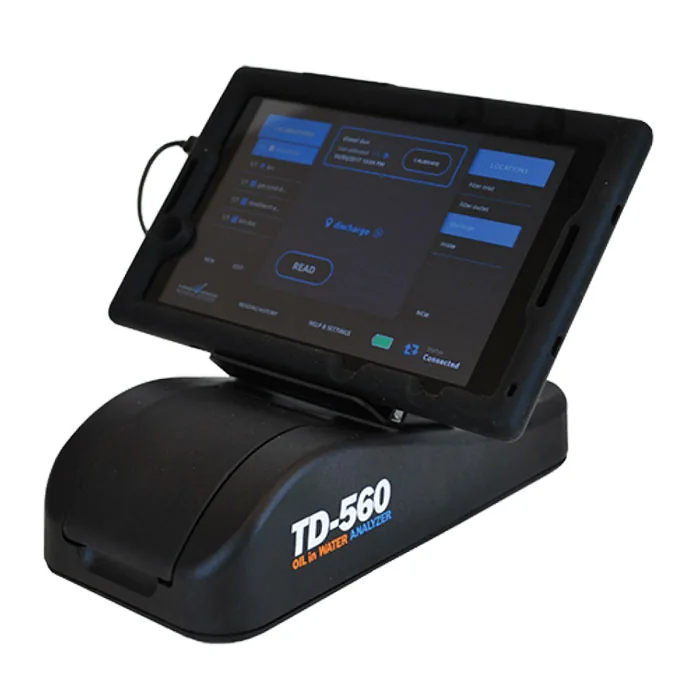
The TD-560 combines the optical channel used in the TD-550 with a second channel for lighter hydrocarbons. It is designed for teams that need to investigate different oil types with a portable analyser.
A full-colour touchscreen supports channel and cuvette selection, calibration and extraction-ratio settings. Saved calibrations and site locations help organise repeat testing without re-entering the same information for every sample.
The instrument records a timestamp, location and result for each analysed sample. Review the history and graphs, then export data using USB or Micro SD for further analysis.
Use direct or raw calibration and retain multiple calibrations for different targets or sites. The chosen oil and preparation procedure determine how to interpret the result.
The manufacturer supports popular extraction solvents and TDHI’s No-Solvent Method. Select and validate the procedure for the sample matrix rather than assuming every sample can be measured untreated.
Sort stored results by date, location or calibration and graph filtered reading history. Logging makes it easier to compare site checks and investigate changes over time.
Published manufacturer specifications are a starting point. Confirm the supplied configuration, target sample and installation conditions with PMA.
UV fluorescence; two optical channels for heavier oils and lighter hydrocarbon targets.
TD-550 targets plus gas condensates, BTEX, gasoline, styrene, phenol, jet fuel, kerosene, heat-transfer fluids and hydraulic oils.
5 ppb–5000 ppm, dependent on target oil. This is a published range, not a universal detection limit for every sample matrix.
External 90–240 VAC power supply; published battery operation of 6–8 hours. Actual field planning should include charging and the intended use.
USB and Micro SD output. Display units include ppm, ppb, mg/L, µg/L and raw signal.
Direct and raw calibration; multiple calibrations and site locations; timestamped sample results and graphing. Manufacturer brochure lists CE approval.
Use a defined sampling and preparation method, with a calibration relevant to the oil being assessed.
Check discrete samples when assessing treatment performance or investigating a changing oil response. Match the reporting basis to the method required for your process.
Investigate suspected contamination in cooling circuits or condensate samples. Representative collection and controlled preparation are essential at low concentrations.
Review the second channel for targets such as gasoline, kerosene and gas condensates. Different compounds and mixtures require appropriate calibration.
The manufacturer lists stormwater and oil-in-soil analysis. Soil work requires suitable extraction and reporting calculations; the analyser is not a direct in-ground soil sensor.
Start with the decision you need to make and the reference method, if one is specified. Establish representative sample collection, preparation, blanks and calibration checks for your target and water matrix.
The manufacturer states that results can be correlated to official laboratory methods such as USEPA 1664A and ISO 9377-1. Demonstrating that correlation requires a validated procedure and representative comparison samples; it is not an automatic equivalence for every oil or application.
The second channel extends target coverage; it does not mean that a mixed sample is automatically speciated into individual BTEX compounds. Confirm channel selection, calibration and the required reporting basis.

Review the measurement principle, published specifications and available features for this product.
Send your sample conditions and operational objective so PMA can review the right configuration.
Read PMA’s existing solvent-free extraction article. Read the TD-550 and TD-560 comparison.
It measures a fluorescence response from a prepared sample using the selected optical channel. Calibration relates that response to a defined target oil or reporting basis.
No-solvent analysis is a supported option, but its suitability depends on the oil, matrix and required result. Agree the procedure and validate it before routine testing.
TD-560 includes the TD-550 channel and a second channel for lighter hydrocarbons. Choose it when that wider target coverage is needed.
Grab-sample oil analysis for crude and heavier oils. Review target-oil calibration, sample preparation and recorded results.
Continuous UV fluorescence measurement for oil contamination, process protection and treatment monitoring.
Continuous chlorophyll-A fluorescence measurement for algae-bloom warning and water-intake protection.
Compare portable oil analysis, continuous oil monitoring and chlorophyll-A measurement with PMA.
Speak to the PMA team about your instruments, reagents or service requirements. Tell us what you need, and we’ll help you find the right next step.
Share your requirements below. All fields are required.
Your enquiry goes directly to our team. Your details are used to respond to you, and you won’t be added to a marketing database. Read our privacy policy.
To find out more about our range of sensors, request a callback or ask a technical question, our expert staff are always on hand. Our focus has always been to deliver world-class customer service.
Get startedWe use optional Google Analytics cookies to understand which pages are useful. Analytics stays off unless you accept. Read our privacy statement.