

Removing settled water from a storage tank is straightforward to describe and more demanding to automate. The instrument must respond to the material at the measurement point, while the control system must make the appropriate decision about the discharge valve.
For UK tank-farm, refinery and industrial process teams, a useful enquiry begins with the operating sequence. Define what may be discharged, where it will go and what must happen when the measurement is uncertain.
1. What interface will the instrument encounter?
A clean boundary between water and hydrocarbon is different from a broad emulsion layer or a changing mixture. Describe the normal fluids, expected contamination and variation over a tank cycle. Include start-up and disturbed conditions, not just a settled sample taken under favourable circumstances.
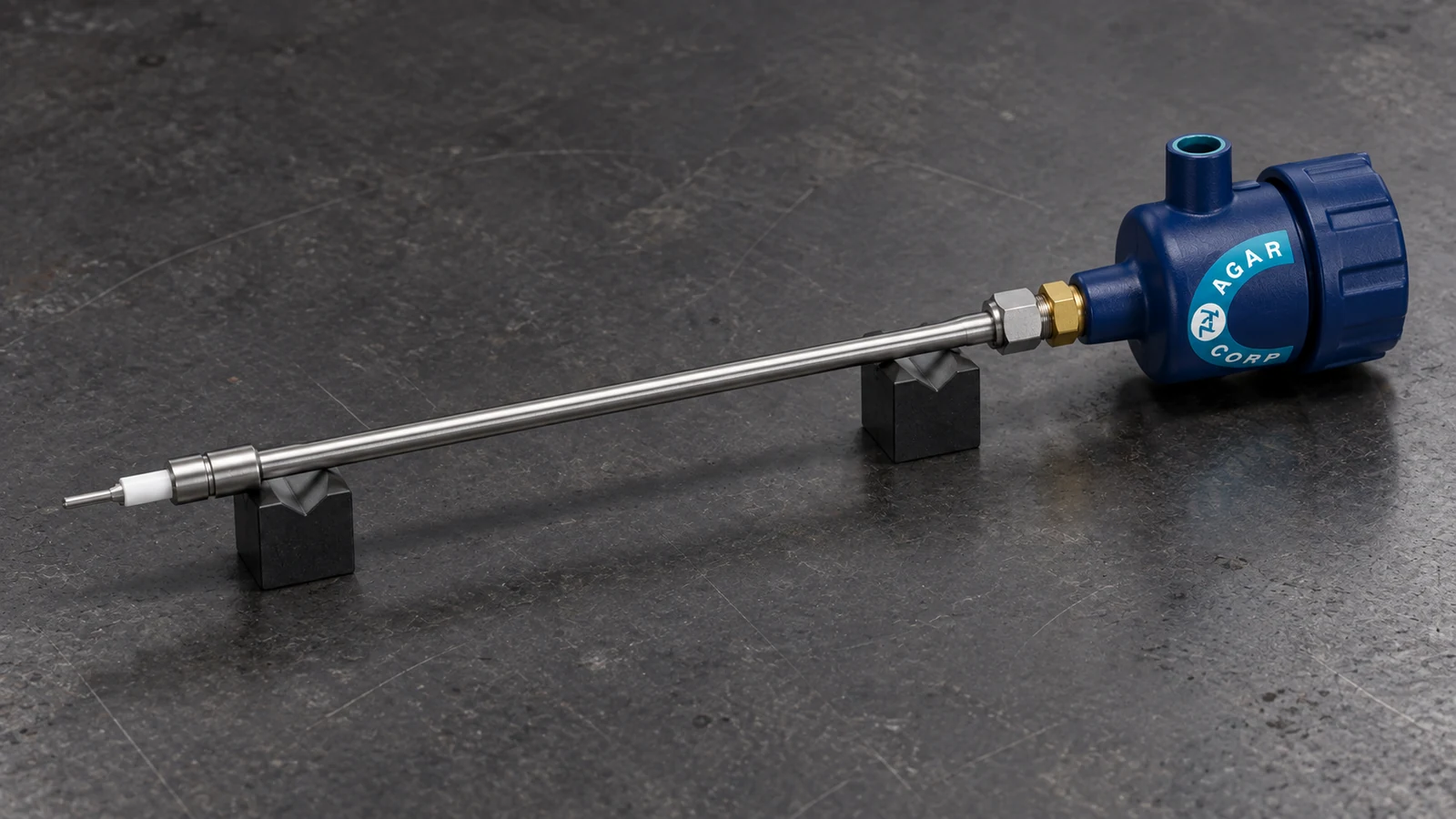
The Agar ID-200 interface detector is used in tank dewatering and desalter applications. PMA’s automatic tank dewatering microsite explains the application context. Instrument suitability still depends on the actual fluids and installation.
2. Is the measurement point representative?
The signal must describe the material relevant to the control decision. Discuss the proposed position, fluid movement, vessel arrangement and possible deposits. A drawing showing the tank, drain line, sensor and valve is more useful than a model number alone.
Provide normal and extreme process conditions, wetted-material requirements and any hazardous-area classification. Use the ID-200 specification and installation guidance as a starting point for a configuration review.
Plan the measurement and response
Plan the interface measurement and valve response together, from the start.
3. What happens between detection and valve closure?
A sensor signal is one part of the system. The distance between the measurement point and valve, fluid velocity, control delay and actuator response all matter to what is discharged. Define the complete sequence with the site’s controls team.
Agree how the logic handles a changing interface, an invalid signal and loss of utilities. Required interlocks and protective functions must be assessed for the whole installation. The presence of an interface detector alone does not establish that a system is fail-safe or suitable as an independent protection layer.
4. How will the system be checked in service?
Allow access for inspection and maintenance. Decide how operators will confirm that the signal corresponds to the process condition and how checks can be carried out within the site’s isolation and safe-working arrangements.
Record commissioning conditions and accepted settings. That baseline helps when a later change in feedstock, fouling or process operation produces a different response. PMA’s UK instrument support can be discussed as part of the enquiry.
5. What information is needed for a quotation?
- Fluid identities, expected phase behaviour and any emulsion or solids.
- Temperature, pressure, materials and area classification.
- Tank and drain arrangement, proposed sensor location and valve details.
- Control outputs, required alarm behaviour and site interlocks.
- Access, maintenance expectations and the intended commissioning checks.
Tank dewatering and desalter interface control should be reviewed against their own process requirements. The desalter application guide covers the latter. Send PMA your application details so we can review an appropriate instrument configuration and scope a quotation.