
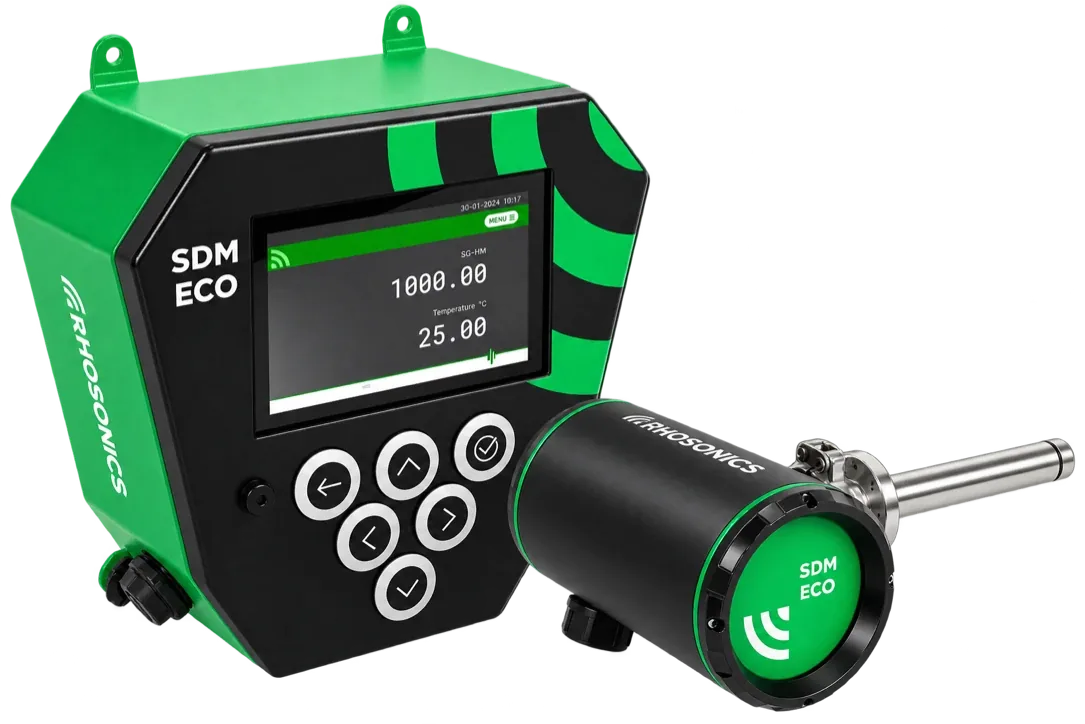
SDM ECO slurry density meter
Continuous non-nuclear slurry density measurement for mineral processing, quarries, dredging and tunnelling.


Inline slurry density and chemical concentration measurement, backed by PMA application expertise and UK support.
A changing slurry density, acid strength or wort extract concentration can affect product quality, recovery and operating efficiency. Continuous measurement helps your team see the change at the point where an operating decision is needed.
PMA supplies Rhosonics ultrasonic instruments for slurry density and liquid concentration analysis. Select the measurement principle around your material: SDM ECO uses acoustic impedance for slurry density, while concentration analysers use ultrasonic velocity with temperature and, where required, a second measurement.
Our role is to connect the instrument with your process conditions, installation point, reference samples and required control-system outputs.
Find the instrument that matches your process. Each product page explains the principle, applications and information needed for a technical review.
Continuous non-nuclear slurry density measurement for mineral processing, quarries, dredging and tunnelling.
Inline measurement of one chemical concentration using ultrasonic velocity and temperature.

Inline wort extract concentration measurement for the brewing process.

Measure two chemical concentrations in a defined liquid mixture using complementary process measurements.

Hybrid ultrasonic analysis for application-specific density, suspended solids and dissolved solids duties.
Start with the operating question, then select the instrument. Our dedicated website provides detailed guidance for each of these application families.
Review slurry density across grinding, cyclone feed, thickener underflow and tailings transport.
Track changing solids loading in wash plants, sand recovery and slurry transfer circuits.
Use density with flow and process context for sediment transfer, production monitoring or bentonite recovery.
Measure defined acids, alkalis and electrolyte mixtures with appropriate materials and process calibration.
Monitor wort extract. For sugar-based wastewater, discuss the separate CCM COD configuration and its validated correlation.
Review liquor and slurry duties where dissolved composition, solids loading and temperature need to be understood together.
Use a representative density trend to support dilution, pumping and thickener decisions. For mass-flow calculations, align density with a suitable flow measurement.
Review chemical replenishment, blending or bath control using the actual formulation, temperature range and reference method.
Observe extract concentration during brewing with a calibration that represents the recipe and process conditions.
Share your material, expected measurement range, temperature, pressure and pipe or tank arrangement. For slurries, include particle characteristics, abrasion and entrained-air behaviour. For chemicals, include the complete formulation and possible contaminants.
Agree the operating decision, required units, useful response time and acceptance criteria.
Review the sensor, wetted materials, fitting, access and control-system connections.
Use representative, time-matched reference samples and record the configuration, output scaling and maintenance plan.
PMA has supported process measurement and analysis since 1971. We bring the instrument, the installation and the measurement objective together.
Share your process conditions with our team. We can help with product selection, application review, commissioning and ongoing support.
Explore acoustic-impedance slurry density measurement and the available installation arrangements.
Compare the 8500 and 9500 measurement roles and the wider chemical concentration family.
Read the manufacturer’s account of SDM ECO density monitoring on a tailings thickener. Results describe that installation.
Choose SDM ECO for a defined slurry density duty, 8500 for one chemical concentration, 9500 for two chemical concentrations and 9100 for wort extract. Review the 9600 family for suitable hybrid slurry-analysis duties. PMA can confirm the configuration for your process.
These ultrasonic measurement principles do not require a radioactive source. The sensor, fitting and operating conditions still need an appropriate engineering review.
No. Suitability depends on the composition, measurement range, temperature, entrained air and installation. Calibration and reference evidence must represent the actual process.
Output and communications options differ by product and configuration. Tell PMA your required analogue signals, digital protocol and control-system arrangement so the integration can be specified.
Speak to the PMA team about your instruments, reagents or service requirements. Tell us what you need, and we’ll help you find the right next step.
Share your requirements below. All fields are required.
Your enquiry goes directly to our team. Your details are used to respond to you, and you won’t be added to a marketing database. Read our privacy policy.
To find out more about our range of sensors, request a callback or ask a technical question, our expert staff are always on hand. Our focus has always been to deliver world-class customer service.
Get startedWe use optional Google Analytics cookies to understand which pages are useful. Analytics stays off unless you accept. Read our privacy statement.